 The Column





Obsidian-Based Project Management System
System design. Obsidian.
Details
Much better than Making an Obsidian Bullet Journal.
After years of iteration, I’ve arrived on an Obsidian-based project management system that I enjoy using, with no asterisks necessary. This page tells all about it.
Overview
Capabilities
- Project management
- With tasks & project notes
- Housing resources used by projects
- Housing templates
- Getting Things Done
ProjectslistNext Actionslist - automatically derived from in-progress tasks in projects- Housing & facilitating my weekly review
Features
- Almost zero overhead - I don’t spend time managing things for the sake of the system, it works with how I manage things naturally
- Templates & resources - don’t repeat yourself
- Reusable modules - don’t repeat yourself
- Weekly notes - Daily notes go by too quickly, weekly notes work better for my brain
- Folder-based project lifecycle management - Projects are
active,backlog, ormaybedepending on which folder they’re in
Vault Structure
Those familiar with Tiago Forte’s PARA method will recognize the basic structure.
- 📁 Projects - for active projects
- 📁 Backlog - for things I know I want to do, but am not actively working
- 📁 Maybe - for things I might want to do
- 📁 Backlog - for things I know I want to do, but am not actively working
- 📁 Areas - for notes about the high-level areas of my life (e.g. health, home, family, etc)
- 📁 Resources
- 📁 Assets - where images & non-markdown files go
- 📁 Templates - for projects, resources, weekly notes
- 📁 Inventory - for housing notes about things I own (warranties, etc)
- 📁 Drawings - for housing Excalidraw drawings (and the
svgexports) - 📁 Modules - for reused modules across my notes (task queries, bases, etc)
- 📁 Archives - don’t delete things, but also don’t let clutter build up in the main folders
- 📁 Archived Projects
- 📁 Archived Resources
- 📁 Archived Areas - e.g. “school”
- 📁 Periods
- 📁 Weeks - for my weekly note
- 📁 Years - for annual reviews & goals
- 📄 Home - a Markdown file, not a folder, the only markdown file in the top-level of the vault
Plug-ins
This is why I like the system the most - it’s not using a ton of stitched-together plugins. In particular, I avoid the Dataview & Templater plugins, which are both incredibly powerful and awesome, but not necessary for how I do things.
- Core
- Tasks - I only use tasks to gain access to the
taskquery functionality - Auto-properties - for promoting in-progress tasks to a
nextproperty automatically
- Tasks - I only use tasks to gain access to the
- Optional
- QuickAdd - more easily creating project/resource/weekly notes, in the right folder, with the right template
- Excalidraw - drawings are good, I set this up in a specific way (more below)
- Calendar - the calendar sidebar is an easy way to jump to a given weekly note
- Optional - purely aesthetic
- Linter - I like having some consistent formatting applied to notes & this manages the
createdandmodifiedproperties - Iconize - adding little icons to notes, similar-ish to Notion
- Style Settings - I’ve dabbled with CSS snippets before, but this is easier
- Linter - I like having some consistent formatting applied to notes & this manages the
Key Notes
Example
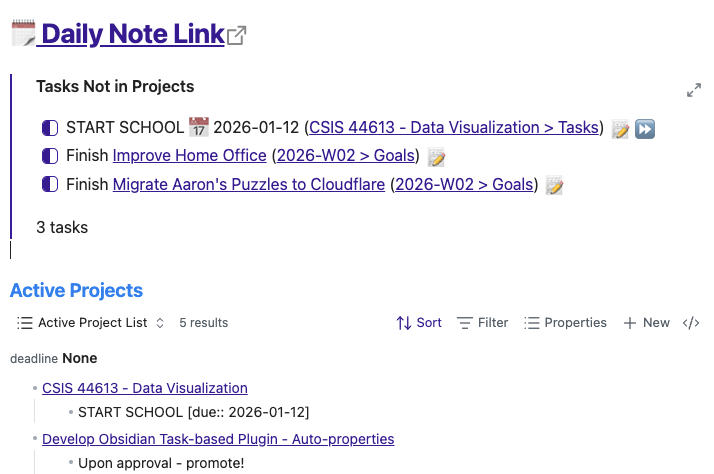
Home
# [🗓️ Daily Note Link](obsidian://daily)

![[Tasks Not in Projects]]

### Active Projects
![[Active Projects.base]]

### Backlog

![[Backlog.base]]
Tasks Not in Projects
NOTE: to make this render properly I had to take out a backtick. The “tasks” query embed requires triple backticks in reality.
``tasks
not done
(due on or before next week) OR ((path does not include Projects) AND (status.type is IN_PROGRESS))
``
Active Projects.base
filters:
  or:
    - file.folder == "Projects"
    - deadline <= today() + "1 week"
views:
  - type: list
    name: Active Project List
    groupBy:
      property: deadline
      direction: ASC
    order:
      - file.name
      - next
    indentProperties: true
  - type: table
    name: Table
    groupBy:
      property: deadline
      direction: ASC
    order:
      - file.name
      - next
    sort:
      - property: file.mtime
        direction: DESC
    columnSize:
      file.name: 332
      file.mtime: 205
Backlog.base
filters:
  and:
    - file.folder.contains("Projects")
formulas:
  Untitled: ""
views:
  - type: table
    name: Backlog
    filters:
      and:
        - file.folder != "Projects"
    groupBy:
      property: file.folder
      direction: ASC
    order:
      - file.name
      - next
    sort:
      - property: file.mtime
        direction: DESC
    columnSize:
      file.name: 332
      file.mtime: 100
newProject (template)
---
created:
modified:
areas:
resources:
image: ""
todos: 0
deadline:
next: ""
---
<span style="font-size: 1.15em; color:orange; padding:0px; margin:0px;">Scope</span>
-

> [!check] Open Tasks
>
>
> ```tasks
> path includes {{query.file.path}}
> not done
> hide backlink
> ```

---
Misc Tips
In lieu of writing a full-blown “how to…”, which maybe I’ll do someday, here are a smattering of tips that made it work well.
Auto-properties
-
Key: “next”
-
Rule: Pull all lines starting with ”- [/]”
-
Key: “image”
-
Rule: Pull first line starting with “![[”
-
Key: “todos”
-
Rule: Count all lines starting with ”- [ ]“
Daily Notes
- Set the “Daily Notes” plugin option date format to
YYYY-[W]WW- this makes it function as weekly notes - The obsidian URLs for daily notes still work, they now just point to your weekly note
Excalidraw
- If you, like me, are really particular about using only durable file formats, you can configure Excalidraw to auto-generate and embed SVGs (or PNGs) in your notes.
- For more, see: https://gillespedia.com/Excalidraw+in+Obsidian
Task Management
- Use Obsidian-native in-line tasks (i.e. just a regular checkbox)
- Mark your next tasks as “in-work” by changing
- [ ]into- [/]. This is what makes the auto-property (and thus: bases) work nicely - This is easier if you change the options in the Tasks plugin to change the task statuses such that tapping an empty checkbox first moves it to “in progress” before moving to “complete”